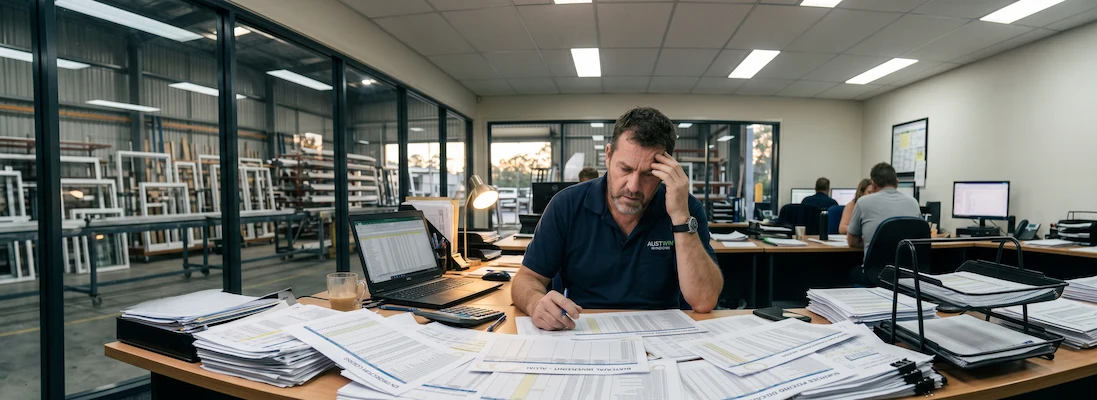
The Hidden Cost of Paper-Based Job Packs for Window Manufacturers
Digital Transformation
The Hidden Cost of Paper-Based Job Packs for Window Manufacturers

You already know what a job pack looks like. Property reference. Address. Customer details. Survey notes. Production information. It goes out with the fitting team and, in theory, it comes back complete.
When the business is small, that loop holds. Someone remembers which van had the folder. Someone chases the missing sheet. Someone reprints it and you still get the invoice out.
Then volume goes up. The loop breaks. And the cost does not show up as “printing”. It shows up as work you have already paid for and cannot bill.
That is the part most senior teams underestimate. Paper is cheap. Uninvoiced jobs are not.
The pack is not admin. It is your licence to get paid.
Lutley Windows, a UK specialist contractor running planned and repair works, managed every job on paper. Each pack left with the fitting team. When the business scaled, fitters regularly failed to return completed paperwork. Office staff had to find it, reprint it and reprocess it. When the pack did not come back, the job could not be invoiced. Some jobs were written off entirely.
Their operations lead put it in terms any director will recognise:
“We have had instances where we haven't had the pack back. So we couldn't claim for that job. That's a massive implication on the business. We sent in a team, which we've had to pay, but we can't charge for the windows or our service because stuff was missing. One person alone was spending a whole week trying to find the work.”
Read that again. You have paid labour. You have supplied product. The customer has the windows. You still cannot raise the invoice because a folder never made it back to the office.
That is not a stationery problem. That is cash leakage.
If you run a factory with your own installers, or you manufacture and hand work to fitting partners, the same failure mode applies in Birmingham, Brisbane, Dublin or Auckland. The pack is the chain of evidence between survey, production, site and accounts. Break any link and someone downstream is guessing.
Where the money actually goes
The obvious waste is the person spending a week hunting for paperwork. That is already bad enough. The quieter costs sit around it.
You cannot invoice, so cash sits in the job instead of the bank. Credit control cannot chase what accounts cannot prove. A missing signature or an incomplete sheet is enough to stall a claim, especially on planned programmes and repair work where the client wants a clean handover pack.
Survey information fails to travel with the order. Production builds from a partial note. The fitter arrives with an incomplete unit or the wrong spec. You have now paid for a factory run, a site visit, and a second visit to put it right. The first visit rarely appears as a “remake cost” on a report. It just vanishes into labour.
Office time gets spent reconstructing the job after the fact. Photos live on someone’s phone. Notes live in a van. The spreadsheet is a day behind the site. By the time a manager asks “where are we on that plot?”, three people are already on the phone.
None of this looks dramatic in a single week. Over a quarter it is hours you cannot sell and jobs you cannot bill.
Why paper fails as soon as you grow
Paper packs assume one thing: the pack will complete the same journey the job does. It will leave the office, survive the van, get filled in on a wet site, come back the same day, and land on the right desk.
That is a lot of faith to put in a folder.
Fitters are paid to fit, not to run a document control system. If the last sheet is still in the cab on Friday, it is not coming back until Monday, if it comes back at all. Repair work makes this worse. Short jobs, more addresses, more packs, more chances for one of them to disappear.
Spreadsheets do not save you here. They just move the same delay into a different file. Someone still has to type what the paper said, if the paper exists.
Senior teams often treat this as a field discipline issue. Tell them to bring the packs back. Tighten the process. Name and shame. That works until you are busy. Then the same people who were “usually good with paperwork” are running late on the last job of the day, and the pack stays in the van.
You do not fix a process that depends on perfect behaviour by asking for more perfect behaviour. You take the handover off paper.
What changes when the pack lives on the job
Lutley moved planned and repair works onto Kanna. The result they care about is blunt. Since they implemented it, they have not had a single job they could not invoice because documentation was missing.
Handover packs are completed digitally. Photos sit on the job, not in a camera roll. Client sign-off is in one place. Managers can check status from a phone, in the office or on a site visit.
That is the operational point, not the software pitch. If the evidence required to invoice is captured as the work happens, accounts stop waiting on a folder. Production stops working from a photocopy of a survey note. You stop paying a fitter to attend a job you later write off.
Field teams will take time to change how they work. Lutley’s did. That is normal. The alternative is keeping a system that already costs you completed jobs.
If you still run paper, price it properly
Ask your office how many hours last month went on reprinting packs, chasing missing sheets and rebuilding a job so it could be billed. Ask accounts how many jobs sat uninvoiced because something was missing. Ask production how often a unit goes out with incomplete survey information.
Then put a number on a single written-off job: labour, product, fuel, and the second visit you will send if the first one was incomplete. That is your real cost of paper.
If you want the detail of how Lutley closed that gap, the full case study is here: Lutley Windows.
Read more

Project Management
Digital Transformation