5 Signs Your Window Business Has Outgrown Spreadsheets
Digital Transformation
5 Signs Your Window Business Has Outgrown Spreadsheets
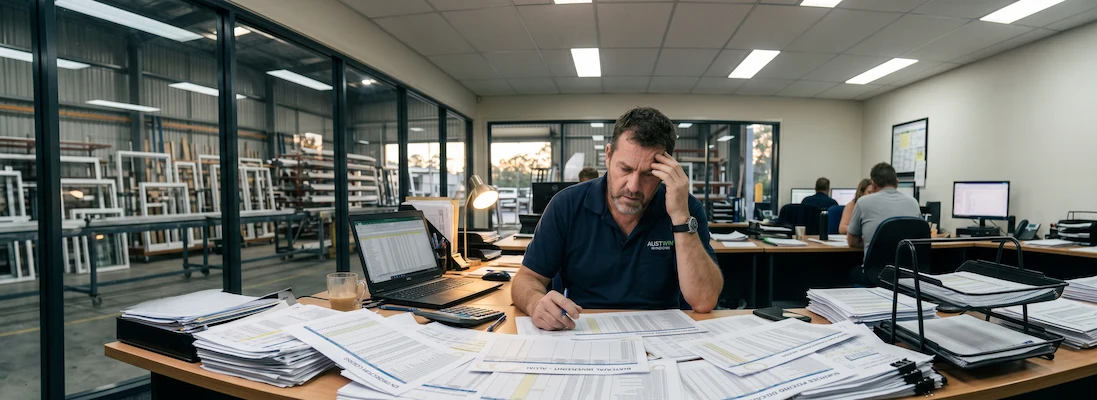
For a while, a spreadsheet does everything you need. It tracks your jobs, holds your customer details, and gives the office a shared place to work. Then the business grows. More teams, more jobs, more people touching the same file. One morning the sheet takes thirty seconds to open, then a minute, then it crashes. That is usually the first warning that you have outgrown it.
Lutley Windows, a Wednesbury-based specialist contractor serving housing associations across the UK, knows this pattern well. The company manufactures and installs windows, composite doors, and glass units, and grew from a small operation into a business running up to 25 fitting teams. For six years, their repairs division ran on a single shared spreadsheet. It held everything, and eventually it held them back.
If any of the following sounds familiar, your business may have reached the same point.
1: Too many people are fighting over one file
A spreadsheet is built for one person at a time. Stretch it across a growing team and it starts to strain. Lutley Windows ran their entire repairs division off one shared sheet for six years. By the end, it crashed on opening, struggled under too many concurrent users, and gave nobody a reliable place to work.
When your team spends more time waiting for a file to load, or working around it, than actually working in it, the tool has stopped serving the business. It is now a bottleneck.
2: Nobody can tell who changed what, or whether it is right
A spreadsheet does not remember. It shows you the current state of a cell, but not who entered it, when, or whether it was correct in the first place. As Lutley Windows scaled, this became a real problem. The business had no way of knowing who had put in what information, or whether it could be trusted.
That matters most when something goes wrong. Without an audit trail, a small error becomes a guessing game. Was the survey figure wrong from the start, or did someone overwrite it? On a single job, that is an annoyance. Across 25 fitting teams, it is a daily source of rework.
3: Work is slipping through the cracks and costing you money
This is the sign that hurts. When jobs live in scattered files and paper packs, things go missing. And in this trade, missing paperwork means jobs you cannot invoice.
Lutley Windows felt this directly. Fitters would fail to return completed packs, and without them, the work could not be claimed. Some jobs were written off entirely. As Senior Contracts Manager Jason Smith put it:
"We have had instances where we haven't had the pack back. So we couldn't claim for that job. That's a massive implication on the business. We sent in a team, which we've had to pay, but we can't charge for the windows or our service because stuff was missing. One person alone was spending a whole week trying to find the work."
A whole week, every week, spent chasing paper. That is a full salary spent on finding work you have already done. If your office is doing the same, the spreadsheet is not saving you money. It is quietly losing it.
4: Information gets lost between your teams
Your business is a chain. Surveyors pass details to production, production passes to fitting teams, fitting teams report back to the office. A spreadsheet only covers one link in that chain, so the gaps get filled with paper, phone calls, and WhatsApp threads.
At Lutley Windows, survey information was not always passing correctly through the chain. The result was fitters arriving on site with incomplete orders. Repair photos and job updates were being shared over WhatsApp, with no central record. When information lives in a dozen places, it effectively lives nowhere.
The signs are easy to spot. Fitters turning up to jobs they cannot finish. Office staff rekeying the same details three times. Important updates buried in a group chat nobody can search.
5: You have no live view of what is actually happening
Ask yourself a simple question. Can you see the real status of any job right now, without ringing someone? If the honest answer is no, your spreadsheet has become a record of the past rather than a picture of the present.
Before Kanna, managers at Lutley Windows had no easy way to check where a job stood. Answering a client's phone call meant tracking down paperwork or asking a colleague to investigate. Now, managers can check any job from their phone, whether in the office, on a site visit, or on holiday. The customer service team can pull up a job in real time and give an accurate answer on the spot.
That shift, from chasing information to simply seeing it, is the clearest sign a business has moved past what a spreadsheet can do.
What comes after the spreadsheet
Many window businesses reach this point and assume the only fix is a custom-built app. Lutley Windows explored exactly that, and the quotes came back at between £50,000 and £100,000, with ongoing maintenance on top.
They found a better option. Kanna gave them the functionality they needed at a fraction of that cost, with the flexibility to build custom reports and match their own workflows. Jason and his colleague Joanne built a glass ordering form with drop-down fields for sizes, thickness, and pattern, turning a WhatsApp message that could be misread into a structured, trackable submission. The manufacturing team now receives jobs directly, with clear visibility of what needs making and when.
The results speak for themselves. Since implementing Kanna, Lutley Windows has not had a single job it could not invoice due to missing documentation. Staff who once spent their days chasing paper are now taking on new work. Even the office team who resisted the change at first have come around.
"We have seen a massive change in the office and the attitude of the people in the office as well. They didn't like it at first when we brought the system in, but now they absolutely love it."
If two or more of these signs feel familiar, your spreadsheet is not the tool holding your business together. It is the thing holding it back. The good news is that moving on no longer means a six-figure investment. It means giving your teams one place to work, Kanna, and getting your time back.
Read more

Project Management
Digital Transformation