Major cuts in postage and stamp costs: Phasing out paper-mailing workflows ahead of the new regulatory requirements.
case study
Kumahira Co., Ltd.
Major cuts in postage and stamp costs: Phasing out paper-mailing workflows ahead of the new regulatory requirements.
Construction Industry
Electricity, Gas, Heat Supply, and Water Services
Wholesale and Retail Trade
Japan
500-999 Employees

Company Name
Kumahira Co., Ltd.
Number of Employees
764
Business Activities
Security Systems, Systems for Financial Institutions, Spatial Planning, Cultural Heritage Facility Systems, Nuclear Facility Equipment
Services
KANNA Project
KANNA Report
Founded over 120 years ago, Kumahira Co., Ltd. is a leading company in Japan’s security solutions market. From equipment for financial institutions and security systems to specialized doors and cultural property preservation facilities, the company plays a major role in ensuring safety and peace of mind across society.
To collaborate effectively with partner companies responsible for construction and maintenance, fast and reliable information sharing is essential. However, relying on emails often led to misunderstandings or missed confirmations, while important documents such as invoices continued to be sent by postal mail—a long-standing practice that resulted in time and cost losses.
With the Act on the Optimization of Transactions Involving Construction Work scheduled to take effect in January 2026, strengthening compliance and accelerating the handling of critical documents have become urgent priorities. In this interview, we spoke with Mr. Takeshi Enoki, Mr. Takahiro Kokubo, and Mr. Ryosei Takahashi from the company’s Engineering Department, who have been leading the introduction of KANNA and promoting its adoption across the organization. They shared the reasons they chose KANNA, how it is being used, the effects of its implementation, and their expectations for the future.
Background And Effects of KANNA Implementation
Issue
Miscommunication occurred over email.
Each partner company used different communication tools, making information retrieval time-consuming.
Exchanges were limited to individual devices, causing work to become overly dependent on specific people.
Mailing documents led to time loss, as well as costs for postage and revenue stamps.
Key Factors For Implementation
Highly customizable and capable of integrating with their system
Strong security features that meet strict requirements such as IP address restrictions
KANNA Reports enables full digitalization of creating, submitting, and receiving forms
An intuitive user interface that anyone can operate without confusion
Effects and Improvements
Shared materials can be distributed to all relevant members, eliminating dependency on individuals
Chat read-receipts greatly reduced the need for confirmation phone calls
Large files can be shared effortlessly, removing the need for external storage services
Digitizing forms to KANNA Reports eliminated time loss and reduced postage and stamp costs
Person Interviewed
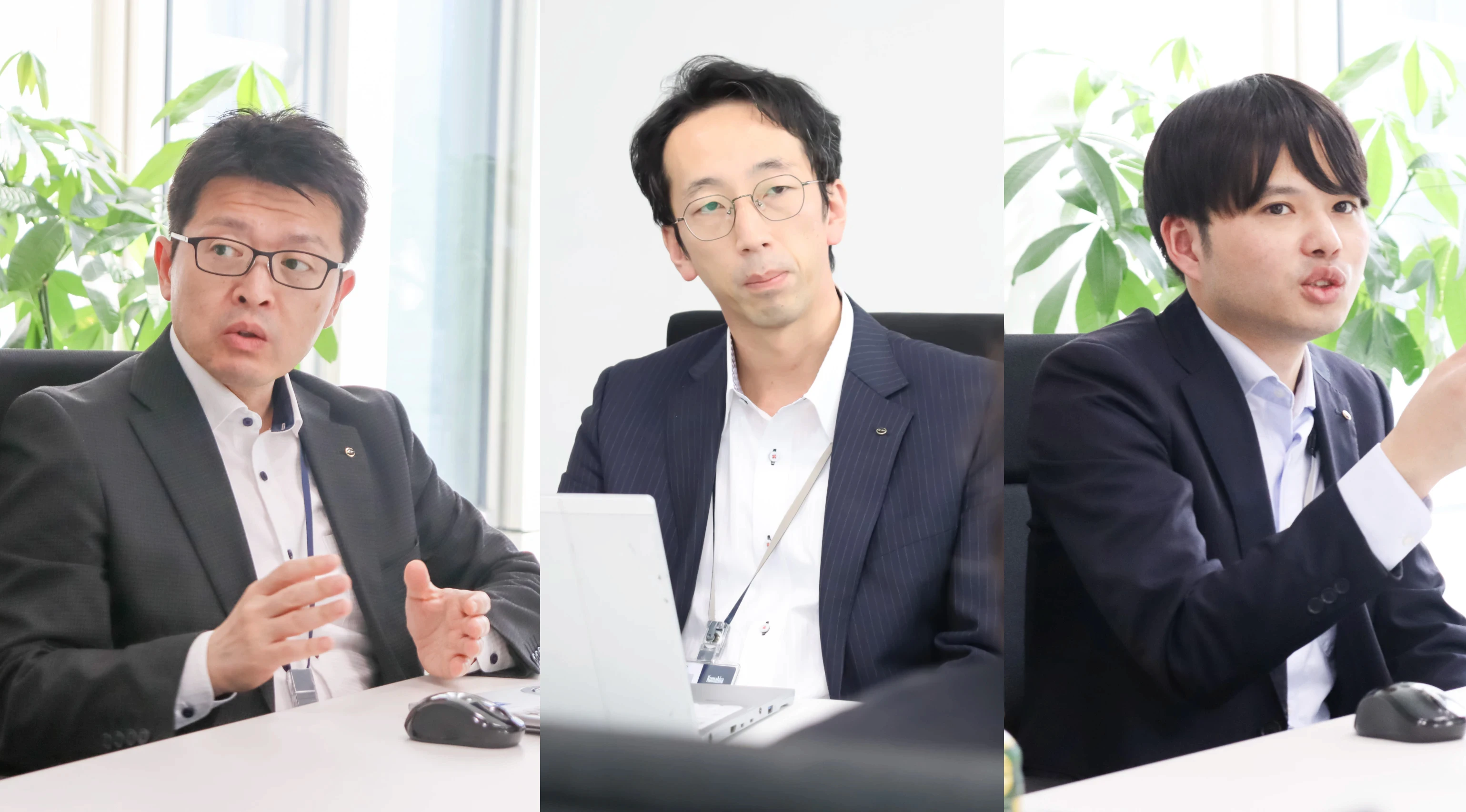
Kumahira Co., Ltd. Ken Enoki — Deputy General Manager, Technical Department, Technical Division Takahiro Kokubo — Section Manager, Saitama Office, Technical Department, Kanto Branch Ryohei Takahashi — Chief, Management Section, Technical Department, Technical Division
Challenges in Information Sharing and Traditional Mailing Practices Faced by a Leading Security Company
— To begin, could you tell us about your business?
Mr. Enoki: We provide a wide range of security-related products and services, including security systems, safes and preservation equipment, planning and design, cultural property preservation equipment, and specialized doors. Since our founding in 1898, we’ve built over 120 years of history and now hold a top share in Japan’s security solutions market. Backed by strong technical capabilities developed over our long history—and a deep sense of responsibility to protect our customers’ assets—we have led the development of domestically produced safes. Today, as a total security company offering solutions such as access control systems and security gates, we contribute to the safety and peace of mind of our customers.

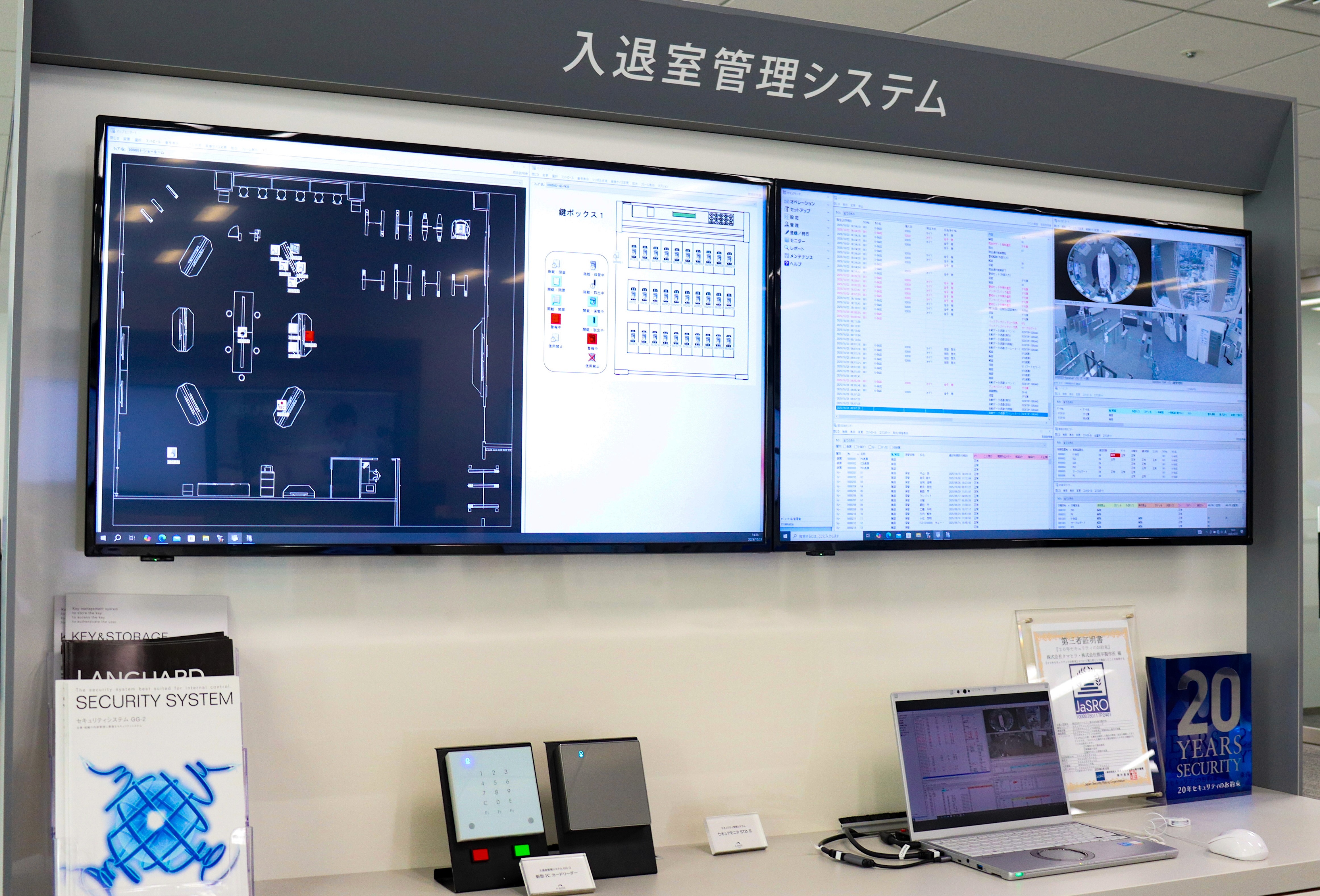
Working closely with our group company, Kumahira Manufacturing, we provide end-to-end services from development and manufacturing to installation, maintenance, and support. With branches and offices across Japan, we offer localized and detailed customer support nationwide. Among these functions, the Technical Department—which handles installation, maintenance, and repair of our systems and equipment—is the team that introduced KANNA. Their work spans a wide range, from advanced digital security systems to physical protection solutions such as safes, preservation equipment, and specialized doors.
— In terms of coordination with on-site teams, what specific challenges were you facing?
Mr. Kokubo: We faced significant challenges in coordinating with our partner companies who handle on-site work such as installation, maintenance, and repairs. For example, the project drawings—which are central to installation work—are updated every time we meet with the client. Each time this happens, we need to share the latest version with our partner companies, but before introducing KANNA, our method of sharing was email.
With email, unless we receive a reply, we can’t be certain whether the recipient has actually reviewed the content. Emails can also get buried among other messages, causing people to miss them, or they may even be accidentally deleted. When drawing updates occur frequently, even our own team sometimes missed sending the latest version despite thinking we had already shared it.
We also ask partner companies to send us on-site photos to ensure high-quality installation, but these would sometimes arrive by email and other times by text message. This inconsistency in communication methods was another issue. Having to switch back and forth between email and text message histories to check information created small inefficiencies that ultimately affected the overall lead time.
Mr. Enoki: We also faced the issue of information sharing being too dependent on individual staff members. When communication happens through email or text messages, all the information remains locked within the personal accounts or smartphones of the person in charge. This prevents the entire department from sharing information, and when that individual is absent, it becomes difficult to respond quickly.
The need for swift processing applies to payments to our partner companies as well. With the “Subcontract Act” being revised to the “Proper Transactions Act” in January 2026, compliance requirements have grown stricter. Ensuring that payments are made without any delays is part of our company’s social responsibility. However, before implementing KANNA, we exchanged invoices, receipts, and other documents by postal mail. This analog process meant it took time for documents to arrive, which could easily lead to delays in payment. Improving the speed of these document workflows was also one of the reasons we introduced KANNA.
“A tool that convinced us we could finally break away from postal mail”
— Why they chose KANNA
Mr. Enoki: In simple terms, our work is construction management. While exploring DX tools to improve efficiency in this area, we came across KANNA. We compared it with several similar services, but KANNA stood out for its exceptional customizability. Since we can easily and freely edit item names for project progress using no-code, we determined that it would allow flexible operations aligned with our core systems.
KANNA also excelled in terms of security. Our business is to protect our clients’ property, safety, and peace of mind. Information leaks are absolutely unacceptable, so we impose extremely strict criteria when introducing external services. KANNA met all of our requirements, including IP address restrictions.
In terms of functionality, it covered everything we were looking for. All documents—such as drawings and photos—as well as communication via chat can be shared centrally for each project. Since all invited stakeholders can check the same information, we felt it would resolve the issue of information being siloed with individuals. What particularly attracted us was the KANNA Reports feature. It allows all necessary forms to be fully digitized, and both submission and receipt can be completed within KANNA. This gave us confidence that we could finally break away from the long-standing issue of analog postal mail.
During our evaluation, we compared KANNA with other services using various criteria, including customizability and security, but the ultimate deciding factor was its intuitive user interface. If our employees and partner companies cannot use it, there is no point in adopting it. Tools with complicated operations never take root. With KANNA, we felt, “This will work,” and that became the final push toward adoption.
Digitizing Paper Documents to Reduce Mailing Costs and Stamp Fees
— After implementing KANNA, what results have you observed?
Mr. Kokubo: The biggest improvement has been the elimination of misinformation such as “I sent it / I didn’t send it” or “I told you / I didn’t tell you.” This was made possible by KANNA’s ability to centralize information sharing. Because KANNA links chat messages with document folders, simply posting a file in the chat automatically saves it to the designated folder. From my perspective as an administrator, being able to complete both sending and storing in one action is extremely efficient. For our partner companies, it means they receive information in a timely manner and can access the necessary materials anytime and anywhere.

Thanks to the read-receipt feature in the chat, we no longer worry about whether the recipient has checked the materials we sent, and both the number of calls we make and the number we receive have dropped dramatically. In the past, we often had to call to confirm whether materials had been reviewed, or partner companies would call us to confirm construction methods. Now, all of that is handled entirely through KANNA’s chat. Since photos can also be posted in the chat, we can grasp on-site conditions with far greater clarity than with verbal explanations over the phone, enabling us to give more precise instructions.
Phone calls haven’t disappeared completely, but now we can open KANNA on a computer browser and talk on the phone while looking at the photos posted in the chat. Previously, even if someone said, “I sent the photos by text message,” checking them while talking required either headphones or switching to speaker mode—small but constant inconveniences. Those hassles are now gone. And having all posted photos kept as records is a major advantage.
Large file transfers have also become much more efficient. Firmware update programs for our security systems are quite large, so we used to rely on external storage services to share them. Now, we simply upload them to KANNA. There’s no need to set passwords, draft emails, or even decide “who needs this file.” It has become incredibly easy.
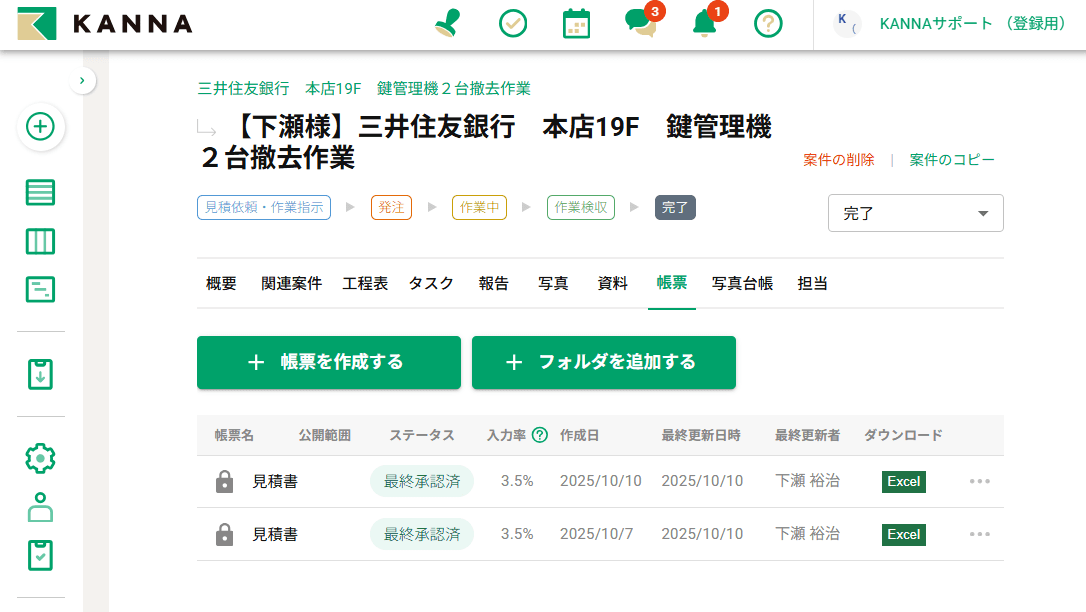
Mr. Takahashi: The impact of KANNA goes beyond information sharing—its effect on handling business documents has been transformational. We digitized all documents needed from project start to completion and payment, including estimates, purchase orders, order confirmations, invoices, and receipts. We also redesigned our workflow around KANNA.
Specifically, when a project begins, we post the work request for the partner company in the project’s KANNA chat. Based on that, the partner company prepares an estimate using KANNA Reports. Our staff reviews the estimate and uses the approval-flow function to send either an “Approved” or “Returned” notice. After approval, we issue the purchase order based on the estimate, and the partner company submits the order confirmation. At the same time, they register the project start date and order amount using KANNA’s reporting feature.
Mr. Enoki: As a result, the time required for handling documents has been drastically reduced. When we were still sending documents by mail, any mistake in a form meant additional delays until the corrected version arrived—it was a huge hassle (laughs). On top of that, every mailed document required postage, and order confirmations or receipts required revenue stamps as well. By digitizing all of these documents, we completely eliminated postage costs and revenue stamp fees. This has undoubtedly reduced the burden not only for us, but also for our partner companies.
Creating an Operations Manual to Ensure Smooth and Reliable Adoption
— You’ve seen various effects from introducing KANNA. Did you take any steps to ensure its smooth adoption within the company?
Mr. Enoki: To determine the most suitable way for our company to use KANNA, we chose not to roll it out nationwide to all branches all at once. Instead, we started small, focusing on two locations: the Head Office Sales Department and the Kanto Branch. While KANNA is intuitive to use, we wanted even employees and partner companies who are less familiar with digital tools to actively use it. Before expanding nationwide, we gathered feedback on actual usability and operational methods so we could build a system that improves efficiency without placing unnecessary burden on anyone.
About three months after the small start, we began the branch-wide rollout. By then, we had created two operation manuals—one for employees and one for partner companies—each roughly 100 pages long. We added links to these manuals in KANNA’s notification feature so that users can quickly reference them whenever they’re unsure about an operation. Takahashi here created those manuals. He’s practically a KANNA expert now (laughs).
Mr. Takahashi: KANNA frequently releases new features, and honestly, it’s hard even for me to keep up sometimes (laughs). But every time a new feature comes out, I test it immediately to see how we can apply it to further improve efficiency. Still, some users may find a manual made only of text and flowcharts a bit hard to approach. That’s why we’re now working on creating a new manual that compiles the operation steps into easy-to-understand videos.
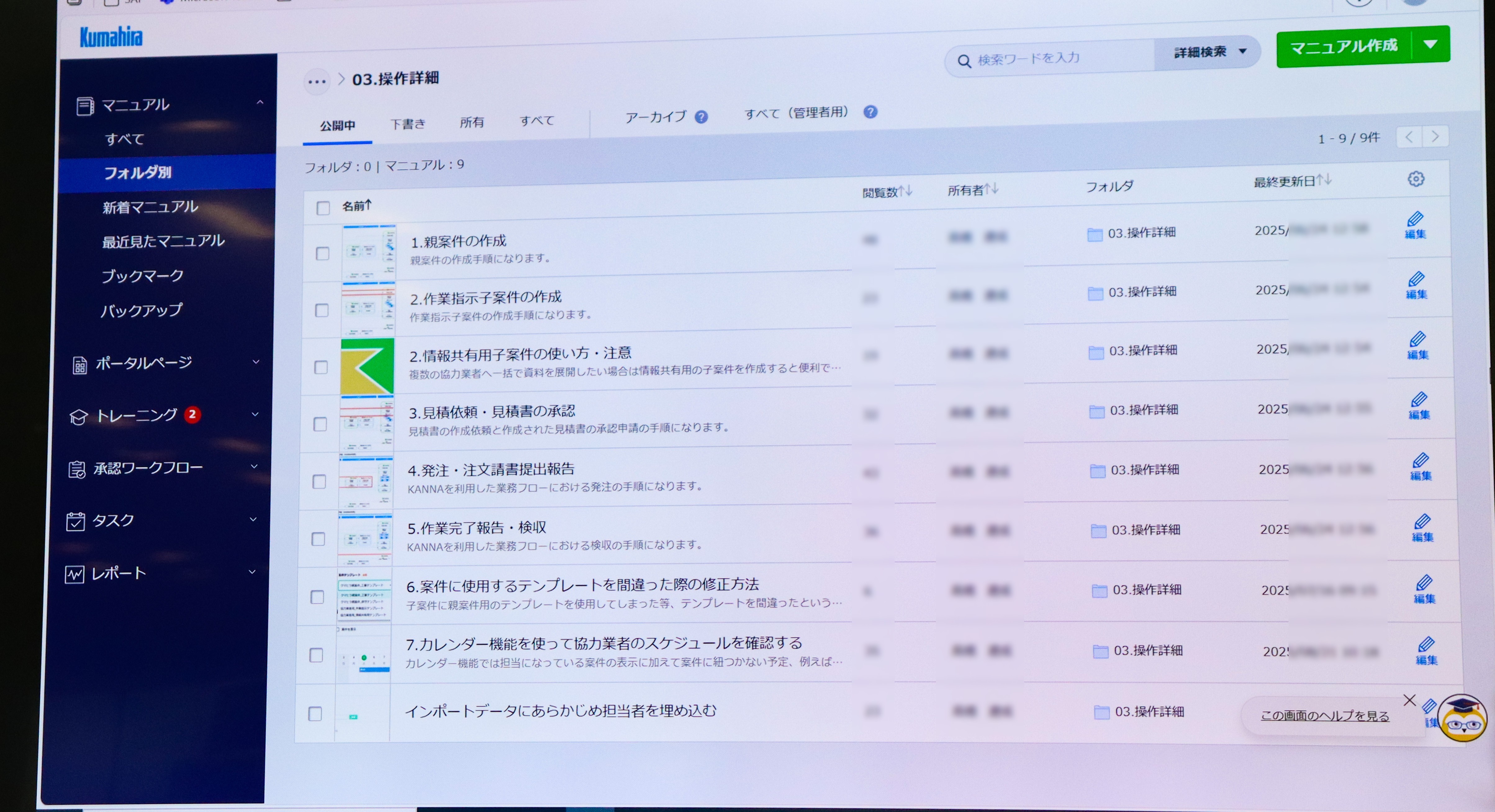
Mr. Enoki: For creating the video manuals, we leveraged an external online service that we had introduced a few years ago. Although it had been in use for about five years, it never really took root and had become more or less a formality. Alongside promoting the adoption of KANNA, we are also renewing our core systems, and we see this timing as a turning point. Our goal is not only to fully utilize KANNA but also to make the most of other services we already have, linking everything to company-wide operational efficiency.
Mr. Kokubo: Of course, support through manuals is important, but for a tool or service to truly take root, it’s essential that each person using it experiences its benefits firsthand. As someone driving KANNA adoption, I actively communicate to both on-site staff and partner companies that “using this will make your work easier.” KANNA has also recently released a new task feature, and I believe it’s important for me to be the first to use it, demonstrating its convenience and acting as a role model.
Standardizing KANNA usage ideas for further operational efficiency
— Looking ahead, how do you envision your workflow and operational structure as you continue using KANNA?
Mr. Enoki: As I mentioned, the benefits of implementing KANNA are clear. Currently, the degree of adoption varies across branches, but branches that actively use KANNA experience efficiency gains and are motivated to utilize it even more, creating a positive feedback loop. This effect has been recognized, and even the department specializing in repairs has expressed interest in adopting KANNA, with plans to roll it out from the next fiscal year.
Since each department has different workflows, collaboration can become difficult and mistakes are more likely, making company-wide standardization of the tool extremely important. Once KANNA usage spreads not only within the technical department but also to other departments, new ideas for how to use the tool will emerge from each branch and department. In fact, the Chugoku-Shikoku branch, which has been proactive in using KANNA, has already started leveraging the calendar function to coordinate partner companies. We aim to standardize these usage ideas as they come in and create a system where everyone involved in operations can experience efficiency improvements.
Article Published on: