From Manual Whiteboards to Digitized Scheduling: Reducing Excessive Callback Work due to Last-Minute Requests
case study
Koen Auto Co., Ltd.
From Manual Whiteboards to Digitized Scheduling: Reducing Excessive Callback Work due to Last-Minute Requests
Automotive Repair Services
Japan
Company Name
Koen Auto Co., Ltd.
Number of Employees
7
Business Activities
Automotive repair & maintenance, automobile sales
Services
KANNA Report
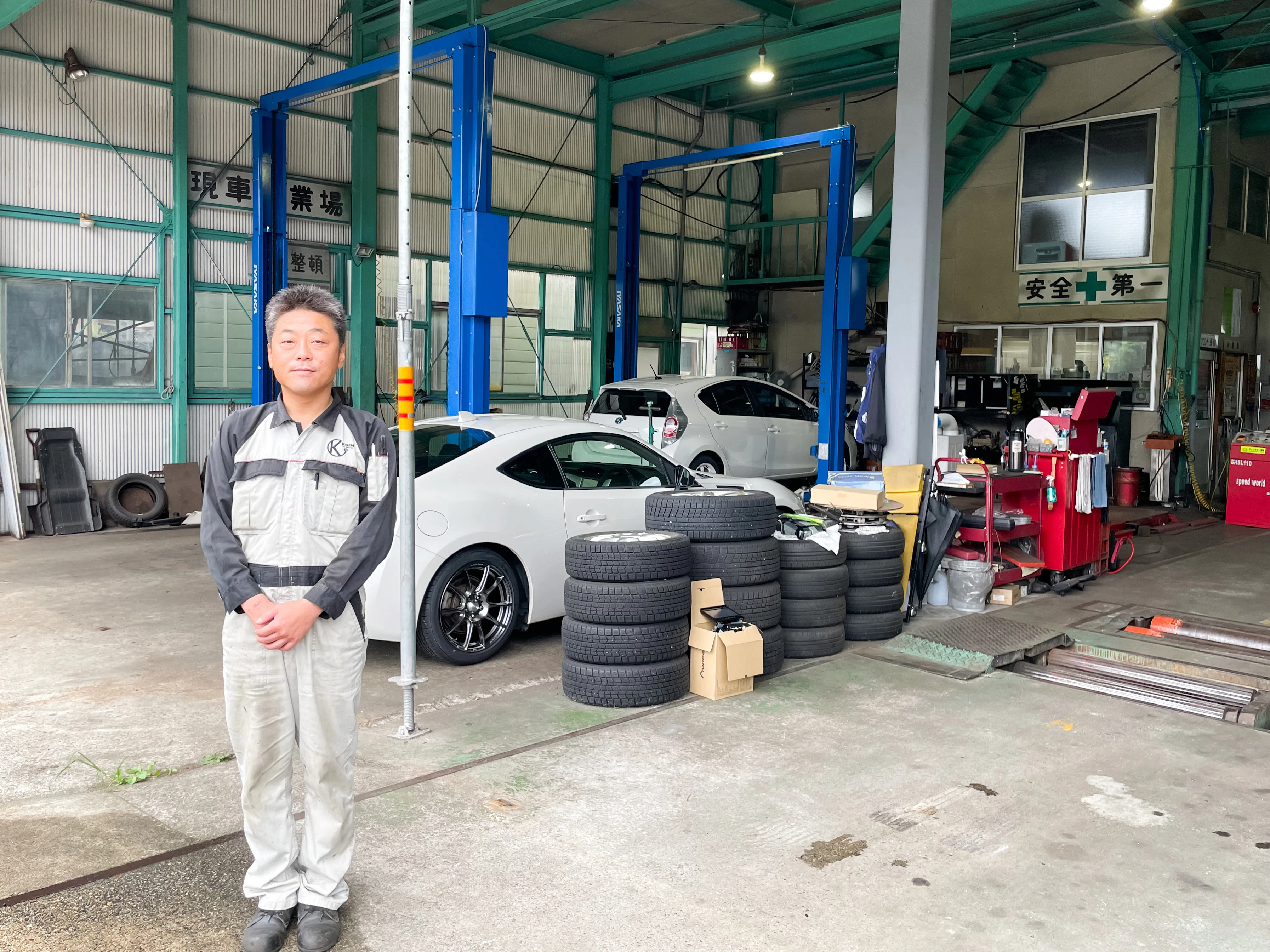
Handling everything from private compact cars to large commercial vehicles—and even municipal fleet vehicles—Koen Auto Co., Ltd. is a trusted workshop serving drivers in Uozu City, Toyama Prefecture. Always willing to assist with urgent, last-minute requests, the company has earned strong confidence from the local community.
However, these frequent “last-minute requests” has led to constant schedule disruptions. Combined with delays in car parts procurement, the workshop struggled with scheduling and efficiently communicating changes in schedule with the mechanics.
We spoke with President and active mechanic Shumei Koen about why he chose KANNA to move away from whiteboard-based management at the office, and how he envisions the future workflow using KANNA.
Background And Effects of KANNA Implementation
Issue
Relying on a whiteboard in the office meant mechanics at the site couldn't always see the latest schedule
Sudden requests while staff were out of the office couldn’t be answered accurately until they returned which kept customers waiting
Each schedule change required reprinting and replacing paper, plus verbal updates — a highly inefficient process
Key Factors For Implementation
A calendar feature that allows staff to check and update schedules anytime, anywhere without returning to the office
An intuitive, smartphone-friendly interface that even mechanics in their 50s and older can use without confusion
Effects and Improvements
Digitalizing schedule management and communication enabled a complete transition away from analog whiteboards
Eliminated the need for “Let me check the schedule and call you back” delays
Removed the hassle of downloading and transferring photos, speeding up these processes
Digitized forms promote a paperless environment, enabling the team to move away from large amounts of physical documents
Person Interviewed
Mr. Shumei Koen, President, Koen Auto Co., Ltd.
Eliminating the Need for Callbacks: Last-Minute Requests and Constant Schedule Changes Become the Norm
— Could you tell us about your business operations?
Mr. Koen: Our core services are automotive maintenance and vehicle inspections, and we also handle bodywork and automobile sales. In addition to private passenger cars, we service large commercial vehicles such as trucks, as well as municipal fleet vehicles—like fire trucks—owned by local governments. Since we accept urgent, walk-in maintenance requests, our responsiveness has spread by word of mouth, and we receive many requests particularly from local transport companies and truck drivers.

— Your company also handles urgent maintenance for large commercial vehicles. What challenges did that create?
Mr. Koen: Our biggest challenge was managing and communicating the work schedule. We used a whiteboard in the office that displayed one month of bookings, with printed slips showing each vehicle's work details. But the whiteboard is only in the office. Since I’m the president and an active mechanic at the workshop, I often receive calls while working. Until I go back to the office and check the whiteboard, I can’t give an accurate response. We end up saying, “I’ll check the schedule and call you back,” which means our customers are left waiting.
Handling schedule changes was also a major burden. When vehicle components had delivery delays, we had to stop ongoing work and switch to other vehicles. Each time this happened, we had to completely redo the whiteboard—removing and reattaching the slips. These changes occurred frequently, and unless we returned to the office often, it was difficult to stay updated on the latest schedule.
That said, mechanics spend most of their time in the workshop. It’s hard to build a habit of constantly checking the whiteboard in the office, so in the end, I was the one who had to verbally relay changes to everyone.
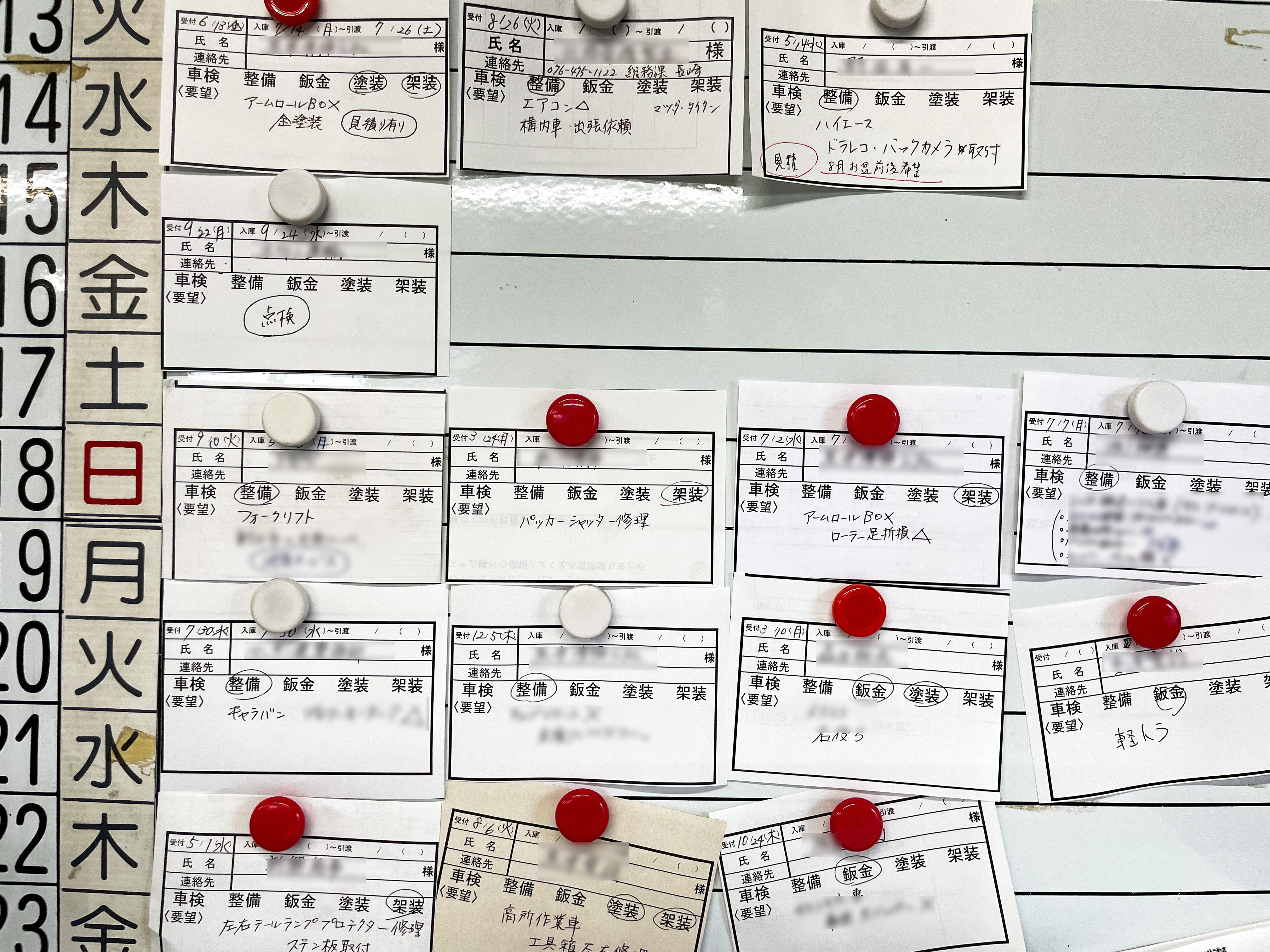
I knew for a long time, that rearranging the paper on the whiteboard and then verbally notifying the team, was an inefficient process. One day, I saw a monitor installed at a partner auto dealership, and I instantly thought, “This is it!” The monitor displayed each vehicle’s work schedule, allowing anyone to see the latest progress at a glance.
I realized that if we could digitize schedule management and communication in the same way, we could eliminate the whiteboard entirely and ensure that mechanics on the floor receive the latest information without relying on verbal updates.
Moving Beyond Whiteboard Management: The Calendar Feature Accessible Even Off-Site
— Since your goal was to digitalize schedule management and communication, what led you to choose KANNA?
Mr. Koen: The decisive factor was KANNA’s calendar functionality. It allows us to register work schedules for each vehicle while linking them to the assigned mechanic, and any changes are reflected instantly. Because we can view all vehicle schedules in one consolidated view, we can place a tablet with KANNA installed in the workshop, enabling mechanics to check the schedule frequently without returning to the office.
In other words, although the structure isn’t exactly the same, I realized we could introduce a system similar to the monitors used at dealerships.
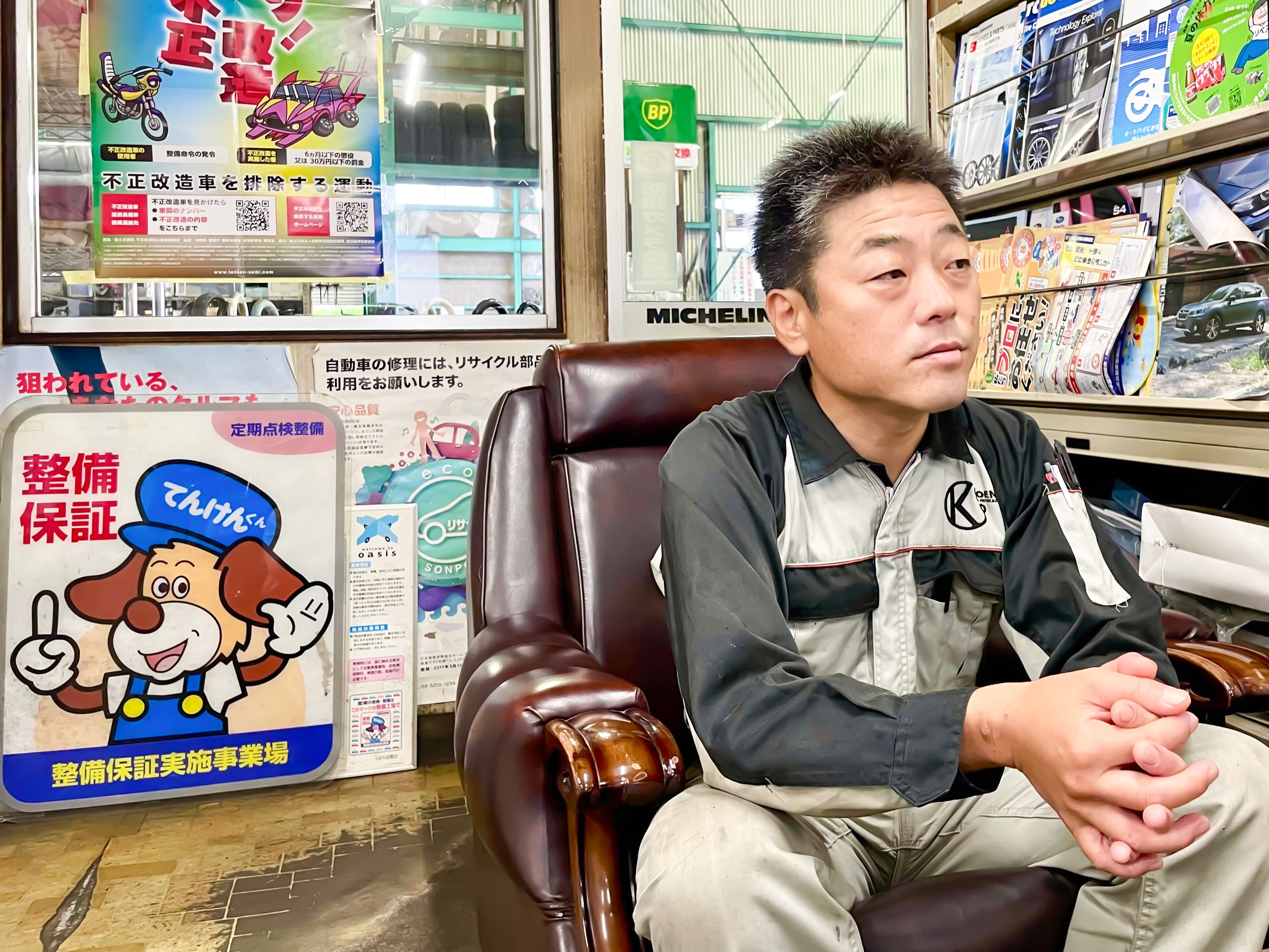
KANNA’s calendar also includes a comment feature, allowing us to share special notes alongside the schedule. Despite offering a wide range of functionality, using the app was extremely simple that I was able to use it intuitively from the trial stage.
Our mechanics range from their mid-50s to early 30s, and since everyone is already accustomed to using smartphones, they can operate KANNA easily and without hesitation.
Reducing the President’s Workload While Enabling Company-Wide Information Sharing
— Lastly, what are your expectations going forward as you fully implement KANNA?
Mr. Koen: As the company’s president, I’m responsible for everything. In addition to managing schedules and doing mechanic work, I also handle estimates, invoicing, and insurance-related tasks. That’s why I have high expectations for the efficiencies KANNA will bring. By utilizing its calendar feature—which gives us clear visualizations for upcoming work—not only can we reorganize schedules more easily, but we can also plan mid- to long-term workloads more effectively.
While the calendar was the initial reason we introduced KANNA, there are many other features we plan to take advantage of. During busy seasons, we outsource bodywork repairs, and when insurance is used, we must provide before-and-after photos. Currently, we ask our partner companies to take photos and send them via messaging apps—but downloading and transferring those files to a PC is a great hassle. If our partners also use KANNA, everything from taking to sharing photos can be handled in one place by managing each vehicle as a single project.
Looking ahead, we’d also like to use the photo ledger and reporting features in KANNA. For municipal vehicles such as those owned by local governments or fire departments, clients sometimes request documentation of the maintenance process. We currently paste photos into Excel or Word files, but with KANNA’s photo ledger feature, report creation could be completed in just minutes. Additionally, if we replace the delivery notes and invoices—currently prepared by our administrative staff—with KANNA Reports, we can transition into a fully paperless workflow.
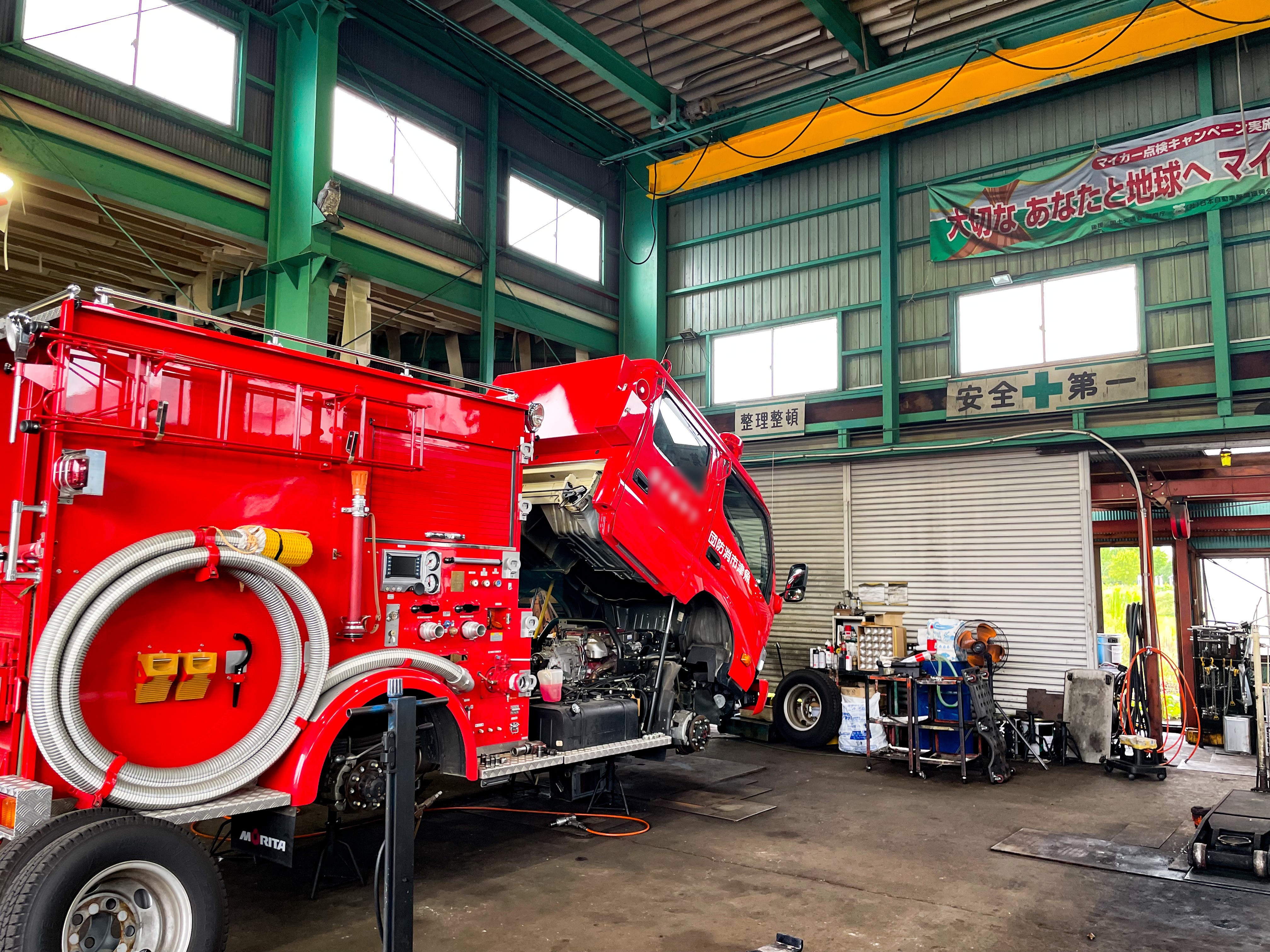
Ultimately, what we aim for is smooth information sharing through KANNA. As a community-based automobile maintenance shop, we’re very close to our customers. It’s not uncommon for mechanics to receive requests directly, and for work to be underway before I, as the president, even hear about it (laughs). But if everyone actively uses KANNA—not only to check schedules but to register new jobs as well—we can share the status of every request across the entire team. We will continue leveraging KANNA to achieve accessible information sharing.
Article Published on: